Visual Humour in Antiquity
Comic bodies, visual puns, parody and caricature in Greek vase-painting — and the question of what made these images funny to their original viewers.
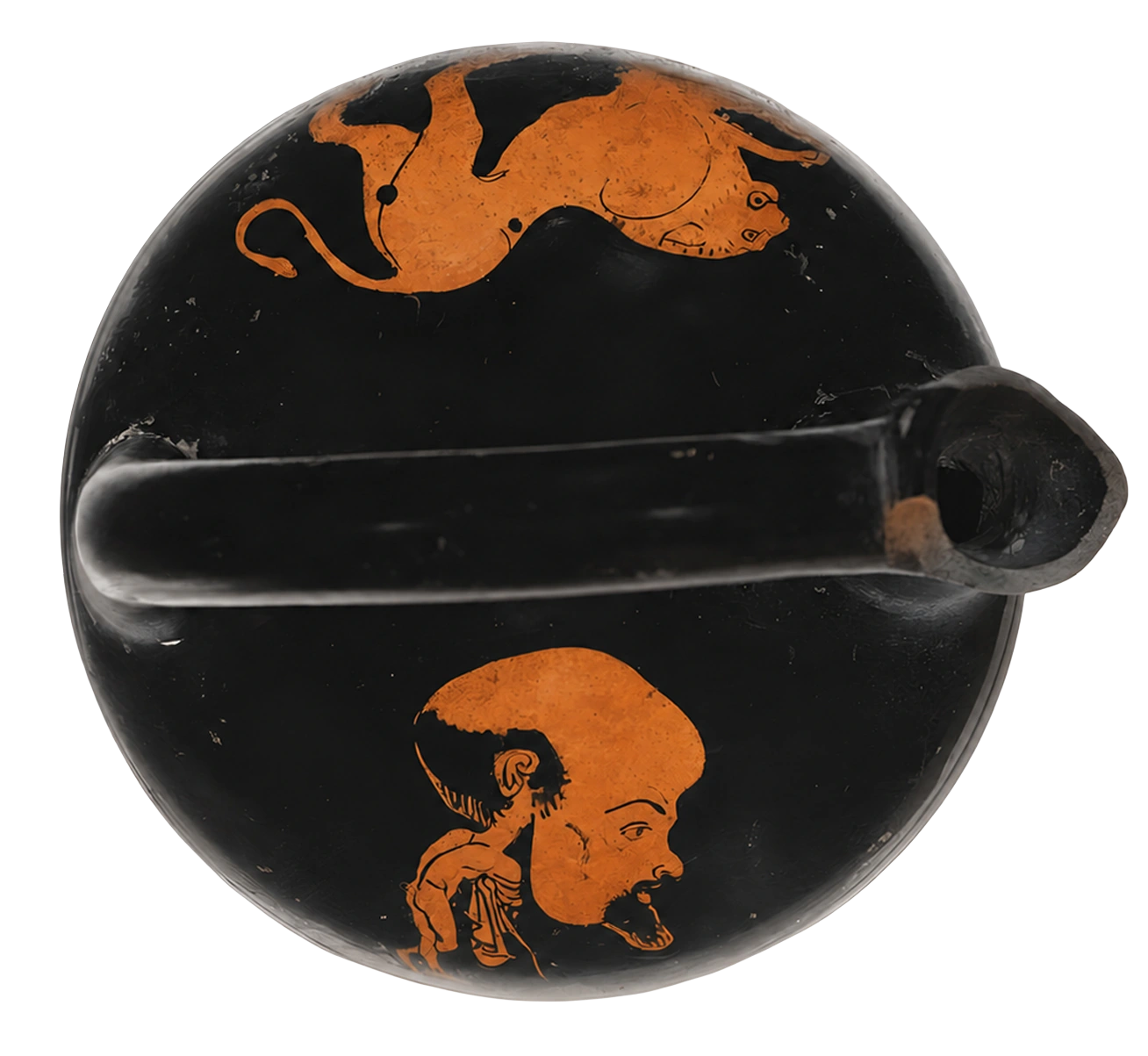
Explore this research Askos, Louvre G 610.Research
My research moves between ancient images and their later transformations: what made ancient viewers laugh, how classical imagery is reinvented in modern political cartoons, and what unusual bodies reveal about medicine, disease and difference in antiquity.
Three research areas
Comic bodies, visual puns, parody and caricature in Greek vase-painting — and the question of what made these images funny to their original viewers.
Explore this research Askos, Louvre G 610.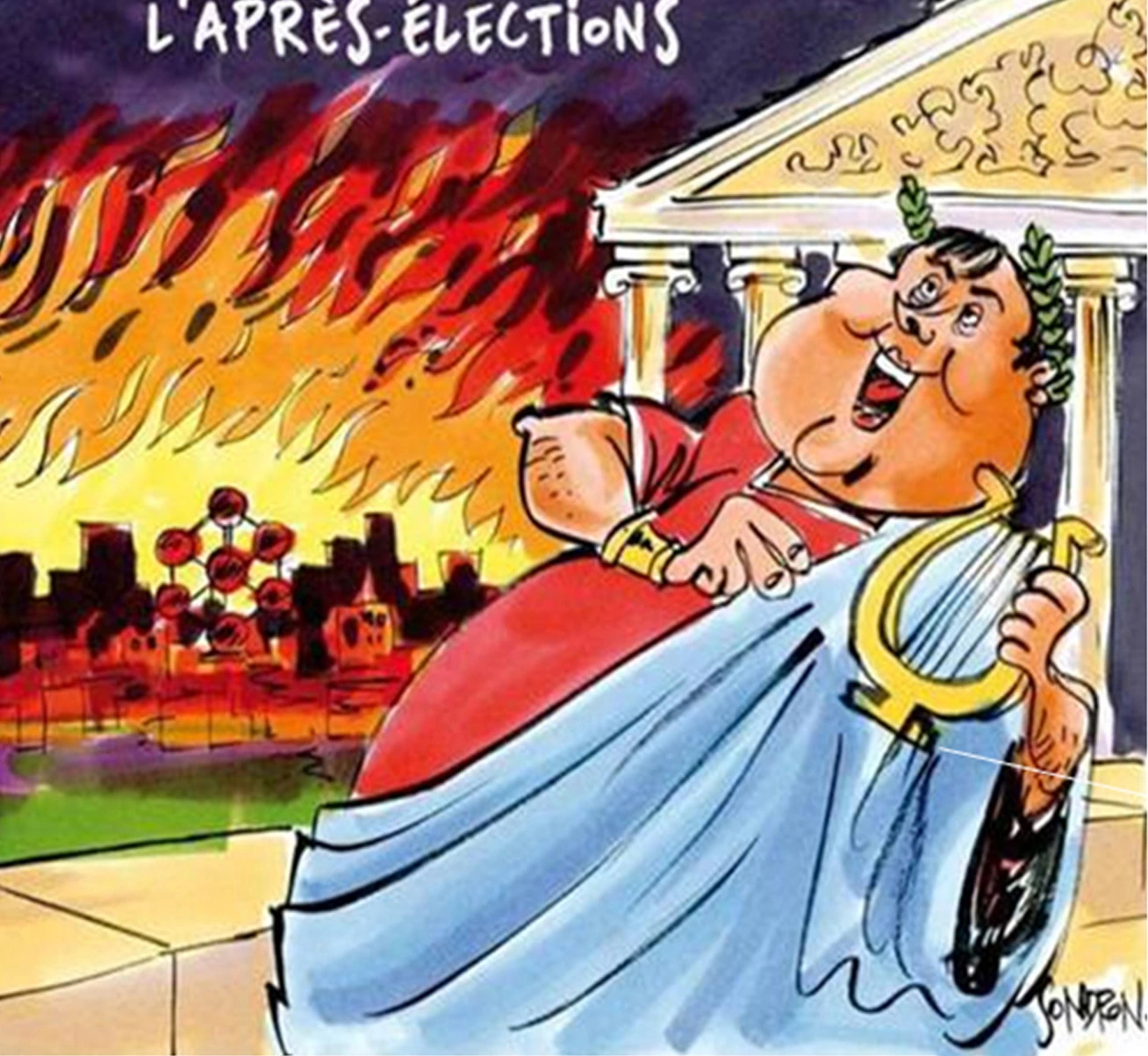
How Greek and Roman myths, figures and visual formulas survive in political cartoons — becoming tools for satire, propaganda and commentary on modern crises.
Explore this research Sondron — Bart De Wever reimagined as Nero.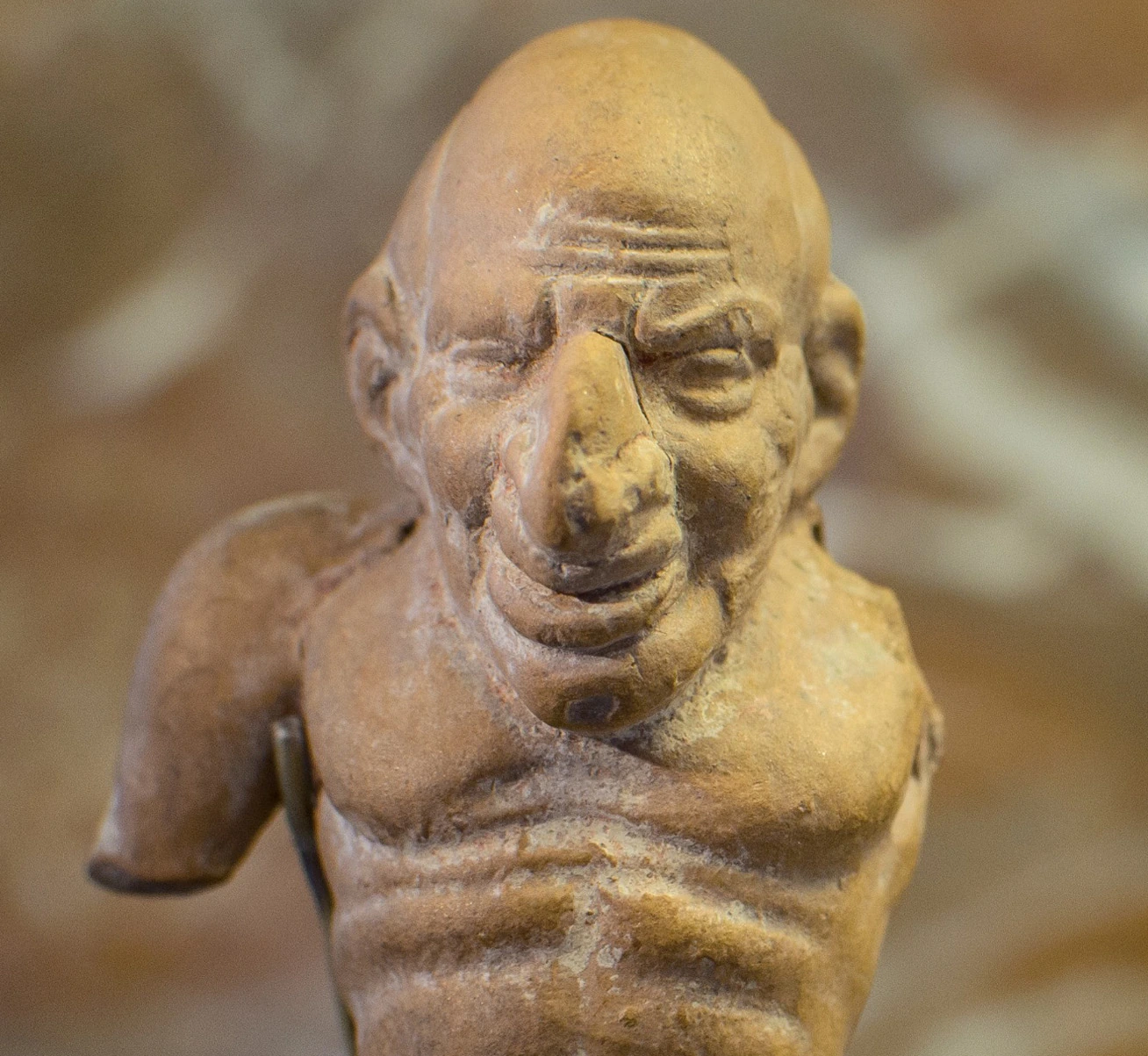
Grotesques, pathology, disability and medical observation: what ancient representations of unusual bodies can tell us about disease, difference and the history of medicine.
Explore this research Grotesque figurine from Smyrna — photograph by A. G. Mitchell.A common method
These three areas are linked by the same habit of looking: taking images that can appear marginal, comic, popular or ephemeral and asking what they reveal about the societies that produced them.
Rather than treating an unusual image as an isolated curiosity, I work comparatively. Repeated images establish conventions; departures from those conventions become evidence. Context, visual codes, material culture and written sources then help explain what an image was doing — socially, politically or culturally.
My research on ancient visual humour began with a deceptively simple problem: if comedy was so central to Greek culture, where was the humour in Greek art?
Greek vase-painting provides an unusually rich answer. Hundreds of thousands of painted vessels survive from archaic and classical Greece, and their repeated scenes create a visual language. Heroes behave heroically, citizens adopt familiar poses, gods carry recognisable attributes and decorative motifs recur from one workshop to another. Once those conventions are understood, deliberate departures from them become visible. A cowardly satyr can take the place of Herakles; an apparently heroic Diomedes can be reduced to a man worried about a wounded finger; decoration can suddenly enter the action. Such disruptions open the way to parody, caricature, situation comedy and visual puns.
The method is archaeological as much as iconographical. I begin by comparing images with images rather than assuming that a literary text must explain them. Repetition establishes the visual code; incongruity, substitution and exaggeration show where that code is being played with. Literary comedy, social history and theories of humour then provide a second layer of interpretation.
The real interest lies beyond identifying the joke. Humour can expose social boundaries with unusual clarity: who may be mocked, which behaviours are considered improper, how gender, status, ethnicity, physical appearance or religion enter comic imagery, and whether laughter reinforces social norms or subverts them. Humour can include and exclude, challenge authority and police conformity at the same time.
More recently, I have returned to this material through the marketplace. Greek pottery was mass-produced, relatively inexpensive and sold competitively at home and abroad. In Laughter in Clay, I examine how humour could attract attention and help create recognition. The potter Nikosthenes is an exceptional case: his signatures can interrupt scenes, follow ornaments or figures, and sometimes appear almost as speech. Authorship becomes display; display becomes a form of branding.
What did ancient viewers find funny? What social rules become visible when they are broken? And could a joke help sell a pot?
Why does a cartoonist reach for Nero, Pandora, Atlas, Caesar or the Trojan Horse when commenting on contemporary politics?
Political cartoons must communicate rapidly. A successful image compresses current affairs, stereotypes, symbols and shared cultural references into a few lines. Classical imagery forms part of that inherited visual vocabulary. A politician can be transformed into Nero or Atlas because the ancient figure already carries associations that the reader is expected to recognise.
My research asks what happens in that transfer. What survives from the ancient model? What is altered or discarded? Why is one classical reference chosen rather than another, and what does it contribute to the argument of the cartoon? The same motif can operate very differently according to period, country, political system and intended audience. Work on Lysistrata posters and on political cartoons from China and Singapore has helped me test that question across very different visual and cultural contexts.
This research now feeds into Echoes of Antiquity, a long-term book project based on many thousands of political cartoons gathered over almost a decade. The aim is not simply to catalogue classical references, but to use political cartoons as historical evidence: to trace how antiquity is mobilised during wars, crises, ideological conflicts and moments of social anxiety.
One completed chapter examines the appropriation of Greco-Roman imagery in Nazi visual culture and antisemitic caricature between the interwar period and 1945. Classical figures, myths and historical references could be altered, inverted and politically weaponised. This chapter has already generated a series of lectures, including the 2025 UCLouvain talk Comment la propagande nazie instrumentalisa l’antiquité gréco-romaine, as well as earlier presentations in Brussels.
Not simply “Where does antiquity appear?” but: why is it invoked here, by whom, for whom, and to what political effect?
Greek and Roman art is famous for ideal bodies. Yet ancient material culture also preserves ageing bodies, unusual bodies, caricatured bodies and representations that may reflect disease or physical difference.
My work in this area grew from a problem of interpretation. Older scholarship often grouped very different objects together under labels such as “grotesque” or “caricature”. But an exaggerated body is not automatically a caricature, and an unusual-looking figurine cannot simply be diagnosed as if it were a modern clinical photograph. The first task is to determine what kind of image we are looking at and what visual conventions shaped it.
Terracotta figurines are particularly useful because they sit outside the monumental tradition that has defined so much of our idea of the classical body. Small, mould-made and widely circulated objects can show ageing, deformity, emaciation, comic exaggeration and other forms of bodily difference. They invite questions about the boundaries between observation and invention, humour and pathology, social judgement and medical interest.
Several publications approach the problem from complementary angles: caricature and pathological grotesques in Roman terracotta; the Hellenistic turn towards bodily difference and anxiety; disability and malformation in the age of Galen; and the longer history of caricature in antiquity. Together they form a study of how ancient societies represented bodies that did not conform to the ideal.
The aim is therefore not to attach a diagnosis to every unusual body. It is to reconstruct the cultural work performed by these images: what viewers recognised in them, what distinctions they made between comic distortion and bodily reality, and what such representations can tell us about attitudes towards vulnerability, difference and the human body.
Less “What disease does this figurine show?” than “Why was this particular body represented this way?”
Now
A study of classical reception in political cartoons, using a corpus of many thousands of images to examine how Greco-Roman antiquity is reused during crises, conflicts and propaganda. Zeitgeist is currently seeking a publisher for the book.
Research backgroundThis project grew unexpectedly out of the archival work for Echoes. Alongside cartoons using Greco-Roman antiquity, I encountered a substantial body of Nazi antisemitic images drawing instead on biblical narratives and figures — material that could not belong in a book on classical reception.
The research examines the striking inversion involved: propagandists appropriated Jewish and biblical sources in order to turn them against Jews themselves, reworking familiar narratives such as Moses, the Exodus, David and Goliath or the Golden Calf into antisemitic visual arguments.
How Pandora and her container are transformed across modern press imagery, and why the myth remains such a powerful metaphor for political decisions, crises and consequences that cannot be put back inside the box.
Research backgroundContinue