The twelfth-century Jewish traveller Benjamin of Tudela is one of the historical figures woven into the imagined journey of the tablet.
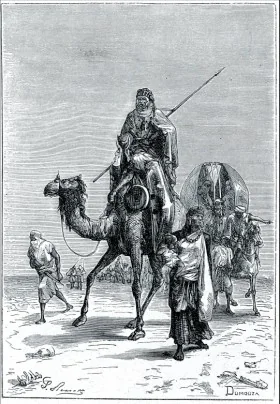
A traveller across three continents
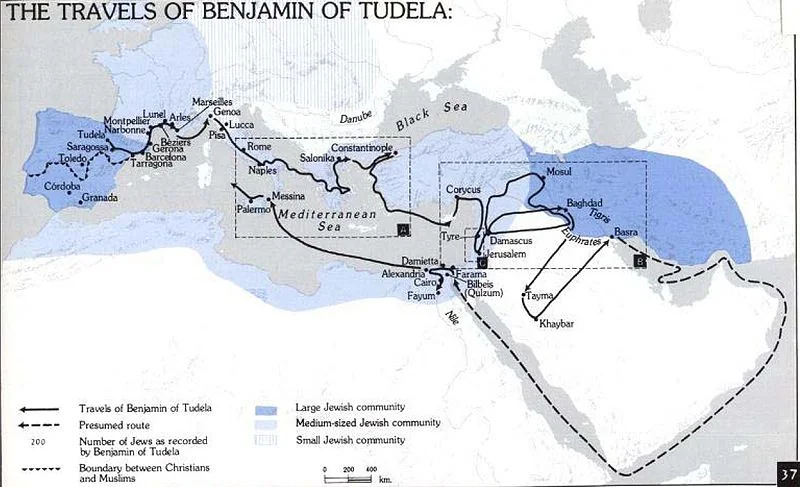
Benjamin left Tudela in the Kingdom of Navarre in the twelfth century and travelled through Europe, the Mediterranean, the Middle East and beyond. His surviving itinerary combines geographical, commercial, religious and ethnographic observations. It is especially valuable for its descriptions of Jewish communities, their leaders and institutions.
His journey took him through Rome and Constantinople, across the Levant and Mesopotamia, and to places directly relevant to the world of The 13th Tablet. In Iraq he describes Mosul, Nineveh, Baghdad and the ruins of ancient Babylon. His account constantly moves between what he saw, what local people told him and traditions attached to ancient sites.
Why he belongs in the novel
Benjamin offered a useful historical bridge between antiquity and the modern thriller. A medieval traveller moving between Jewish communities could plausibly encounter stories, manuscripts and objects whose significance had already changed over centuries.
He also allowed the novel to allude, lightly, to a much larger scholarly problem: texts and traditions do not move through history in a straight line. They are copied, retold, mistransmitted, rediscovered and reinterpreted.
Benjamin of Tudela, The Itinerary of Benjamin of Tudela, trans. Marcus Nathan Adler; J. Shatzmiller, “Jews, Pilgrimage, and the Christian Cult of Saints: Benjamin of Tudela and His Contemporaries”, in After Rome’s Fall (1998).