Mina’s tablet is fictional, but for the launch of the novel the imagined object was made physically real.
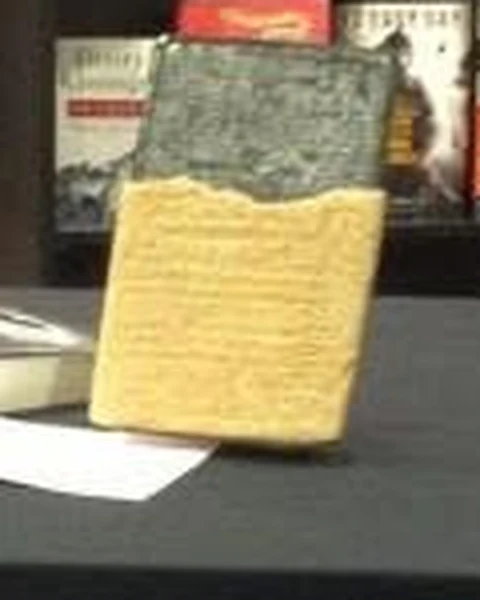
From description to object
The prop was produced by sculptor James A. Matthews from photographs, drawings and notes that I supplied. It was conceived as a composite object: an inner dark “stone” tablet enclosed within an outer clay-coloured casing.
The modern rendering itself was made in resin, with black pigment used for the inner tablet and orange-yellow colouring for the casing. The aim was not to manufacture an archaeological fake, but to give physical form to the object described in the fiction.
Why make it?
For an archaeologist, objects are rarely abstract. Weight, texture, damage, fabrication and the relationship between an inscription and its support all affect the way an artefact is understood. Producing Mina’s tablet was a playful way of reversing the normal process: instead of reconstructing an ancient object from archaeological evidence, a sculptor reconstructed a fictional one from an archaeologist’s description.